Monday, February 12, 2007

Picture post


I've finally got round to developing the pictures from my film camera, so here are a few of them.Above is my home, the Croft, covered in snow. Just three days before we'd been sitting in the garden drinking gin and tonics in the sun. (By the way - if you look upwards from the apex of the conservatory to nearly the very top of the trees behind, you can see a small speck. That's the magpie nest I mentioned in my last entry.) Next are the rocks at Shakira, just down the hill from Philipe's vegan farmstead. This is where he comes to drink his home-grown coffee every morning. The view from here is amazing - far, far below the Rio Magdalena cuts through green hills, that have twelve waterfalls cascading down them. The following are some of the monsters that litter the countryside all round San Augustine.


This is the racing butterfly that came and landed on me while we were walking around one of the archaeological parks. I wonder what happened to the other eighty-eight of them?

This is the pleasant little guest house we stayed at in San Augustine.

Ah, back to Shakira. This was taken from near the rocks where we were sitting in the first picture. I somehow managed to miss all of the waterfalls. That's Chappy on the horse. He's from Middlesborough, him, like.

I think the next four pictures were taken around Salento when we went to visit the coffee finca.


This is the main square in Salento. You can see the mists rolling off the mountains to the right.

Here is the night-time view from the cabin in Taganga. What is incredible is that absolutely nobody in the village pays for their electricity. Everybody just hooks a coat hanger up to the power lines.
This is the beach at El Cabo, in the Tayrona national park, where we spent New Year.
This is Pershore Abbey covered in snow. It once extended to about where I took the photo from, but most of it was knocked down in Henry VIII's dissolution of the monastries. It was all supposed to be demolished, but the people of Pershore had a whip-round and gave the wrecking squad £400 to leave the part that remains today. The butresses were added in 1911 to stop it falling over. I've always thought they make it look like a puppy sitting up waiting for a biscuit.
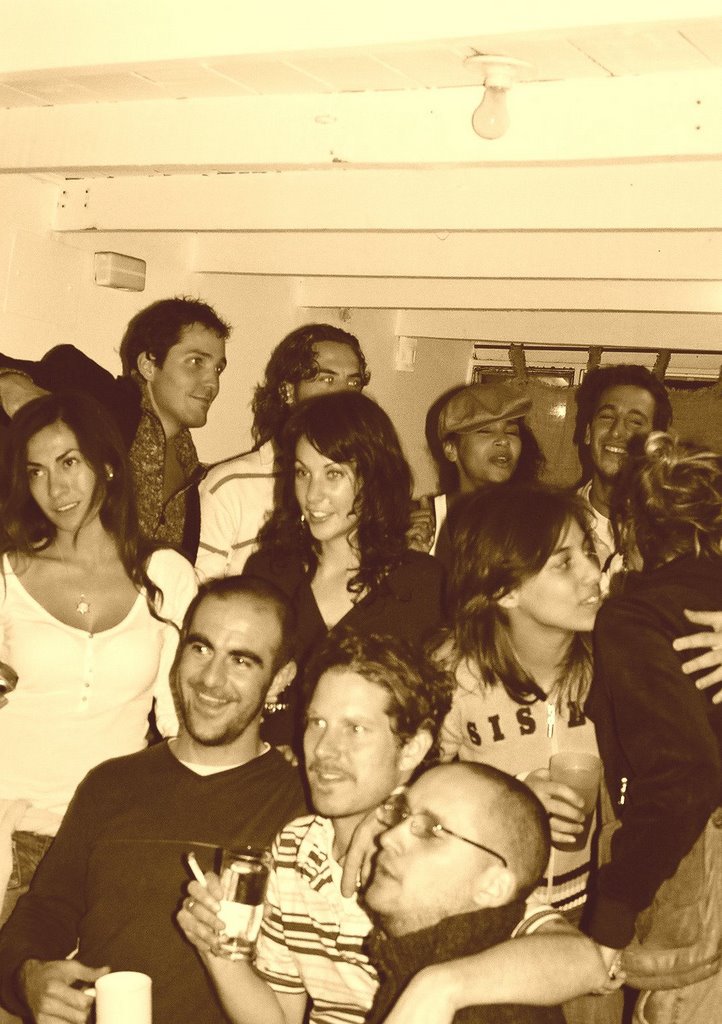
This is one of my favourite pubs, The Fleece at Bretforton. It's an incredibly historic place - it has one of Englands largest collections of pewter plate and there are designs painted on the hearth tiles to stop witches coming down the chimney. One of the last stories I wrote for the Evesham Journal was my eye-witness account of it burning down. It's since been immaculately restored. My cousin Andy is getting married to Eleanor there in June.

Thursday, February 08, 2007

The Weather

Coming home for Wassailing was quite momentous - aside from the hundreds of quid I spent getting here. Last year I left Blighty on Wassail night, so coming back for this year's celebration should (you'd imagine) be the chance for some introspective and insightful words about how I have trundled my way through the dozen months in between. (What I've learned, how I've grown, n'all that.) But that doesn't come easily to me, so instead I'd like to talk about the weather.

I woke up this morning to find the world covered in a thick blanket of snow. I won't describe it - just try to imagine everything covered in a thick, white, cold blanket and you'll get the idea. I was very excited - it's the first proper snow we've had in this part of England since the early eighties; when Dad used to tie our sledges to the back of his car and drag us round the lesser-used lanes of the Cotswolds.

It's a shame really - for the past few weeks the weather has been unseasonably warm. The birds have been flying around collecting twigs for nests, squirrels have been emerging from their winter hidey-holes and I've even seen a couple of butterflies. Of course, they're all buggered now, poor sods. Apart from the magpies that is. Last year they nested in a birch tree by the tortoise enclosure, so Dad poked their nest out with a stick (for those who don't know - they are terrible predators of song birds). But now they seem to have learned - they're building their nest at the very top of the tallest poplar tree in the garden. But they'll probably be buggered too after this weather.

The weather on Wassailing night was very pleasant. It was the middle of an English January in the middle of the night, but we all sat outside quite happily. I suppose we all had our cider anoraks on to keep us warm. For those who don't know; Wassailing is about opening a new barrel of cider and then thanking the trees for their bounty. It's a complex ritual, involving several guns, some toast and a virgin. It all went very well, and I have high hopes for next year's apple crop.

My last week in Bogota was unusually warm. Even though I'd just come back from the Caribbean coast I still managed to get sunburnt on the few occasions I left the house. It was a particularly pleasant night when I went to a wedding with Dodgy Dave, from Hitchen. We arrived about three minutes late, and as English people we were worried about being tardy. As we walked in Dave was approached by a stunning bridesmaid in a scarlet dress who told him he was was best man. "Why did nobody tell me?" he asked. She giggled and pinned a rose to his chest.

Later in the evening I won my first ever dancing contest. All the single men at the wedding had to grab a girl and shake their stuff in front of a crowd of baying aunties. I shook mine, and by common consensus my ridiculous wiggling won me the bride's girdle. I was genuinely shocked - all the other fellas were doing all sorts of salsa things and I was just being very silly. But the aunties had their way and I was victorious.

After the wedding I headed on to a friend's club where he was celebrating David Bowie's birthday. I milled around for a while making disparaging remarks about boss-eyed paltroons before going home.

Next thing I remember I was at an airport near New York, and it was snowing. Nothing like British snow, of course, but I appreciated the effort.

And now I'm in writing this in the study of The Croft. It's a good place to pretend to be an explorer. As I look around me I see Nubian swords, ostrich eggs, dried starfish, Ethiopian birthing stools, stuffed birds and one of those fish that sing 'Take Me to the River' when you bark at it. Oh, there it goes again.

Tuesday, January 09, 2007

John & Nicole Picture Special

I have been taking pictures recently, but on a film camera and I haven't had the chance to get them developed yet. In the meantime here are some pictures taken by John and Nicole, which are probably a lot better than anything I have waiting on my films.


Their pictures start on our horseride in San Augustine, about ten minutes after I fell off my horse, while attempting to clamber on. As you can see I have mud on my knees and a sheepish look about me.
The countryside around San Augustine is absolutely lovely. The picture below was taken from an ancient archaeological site called Shakira (no relation), where figures have been carved into a pile of rocks on a hillside. They must have been bored. The site is actually bounded by land belonging to Philipe, he wanders down to have his morning coffee contemplating this view. You can't see in this picture, but from the rocks you can see twelve waterfalls cascading down the hills in every direction. It's amazing that this picture missed them all.
This is Popayan, which I think is the most elegant town I have visited in the New World.
Again, Popayan.
This is how the Indians in the south of Colombia dress. In the north the Tayrona Indians are completely different - they dress all in white with pointy hats.
The countryside around Salento was even nicer than around San Augustine. But everywhere you go in this country there are amazing vistas.
This is the old chap at the coffee finca we visited.
And these are his grandchildren. Really, they must wonder about the one on the left. It's about six years since they opened their farm to foreign visitors . . .
As well as the coffee, Salento is also the place to go if you really must see the tallest palm trees in the world.
This is up in the slums of Medellin. Just incredible how happy everyone was up there.
This is the cablecar that travels over the city.
Nicole will probably hate me for using this picture - but it's the best shot of the view from our cabin in Taganga. And that pose is great.
This is the beach at El Cabo, in the Tayrona national park.
The picture was taken from here, were we camped. You can see just how far those coconuts would fall before landing on your head. I never knew such terror could lurk in paradise.
The threat of instant death brought out the hedonist in everybody.

Festivities

After arriving back from Medellin it seemed Christmas was just round the corner. Bogota had emptied out completely, it seems everybody here has a second home somewhere on the coast or in the hills, and there they all go for the festive season. I think even the homeless fellas must have weekend boxes somewhere, or ditches in the country. It's strange that everyone clears out, because with the absence of crowds (and bedecked everywhere with lights and tinsel) Bogota is the most remarkably Christmassy place.


Almost as soon as I got back Dave and I made a start on sorting out the Christmas lunch, our preparations turning into a 72-hour drinking and peeling session. There was a lot to do, we were expecting more than 20 people. As it turned out there were closer to 30 guests, but the food went round OK. We started off with a cold sideboard of pickles, nuts, olives, meatballs and asparagus wrapped in parma ham. The main course was turkey and beef fillet, with sprouts, roast potatoes, caramelised onions, roast turnips, carrots, stuffing, gravy and cranberry sauce. This was followed by bread and butter pudding then a giant platter of cheese and biscuits. The eating turned into dancing, before dissolving into a drunken game of jenga – and all the while there was plenty of laughing and a fair bit of flirting. I never imagined Christmas could be so much fun without the Queen's Speech.


After recovering for a day or so Dave and I headed out to catch a bus up to the north coast, where John, Nicole and Chappy have been soaking up the sun since before Christmas. We were quite doubtful if we would be able to find a bus, because the migration to the coast continues into the new year. On the way the taxi driver told us that there had been a bomb near the bus terminal. We asked him if many people had been killed. He looked at us in the rear-view mirror and with a resigned grimace said: “Many”. Nothing more than that – it really made me wonder how people can be so resigned to violence here. But at the same time I heard myself think: “Oh good, there should be some free seats then.” That made me feel rather callous.


The journey was about 20 hours, most of which passed by in sleep. While I was awake I was again struck by the sheer beauty of the Colombian countryside. It's got everything. One moment you're in a lush green river valley with Hereford cows grazing under stands of trees, the next you're winding through dense jungles.


Santa Marta, the bus's destination, is a scruffy seaside city with a real end-of-the-pier atmosphere. It's the oldest town in Colombia, founded in 1525, although today it's difficult to spot much of historical interest behind the bustling commerce and cheerful crowds. Appropriately, it being Colombia's answer to Blackpool, it was where Simon Bolivar, the Great Liberator, chose as his place of final rest - he died there in 1830 as a penniless 47-year-old who had seen his dream of a Gran Colombia shattered.


From Santa Marta it was just a ten minute taxi ride to our final destination, Taganga, where John, Nicole and Chappy were waiting for us. Because Dave had lost his mobile phone on the bus, we had no way of getting in touch with anyone to find out where we were staying. Even though Taganga isn't the biggest fishing village in the world, it was crammed with people, mainly Colombian, and most of them from Bogota. We decided our best option was to sit tight in a bar and wait for them to walk past us. We did this for a few hours until we realised that we had been sitting within 20 yards of them all the time.


Throughout that time I noticed that I'd been getting some funny looks off people. I was quite baffled until Dave pointed out that I was the only person on the beach in the heat of the midday sun wearing pajamas and carpet slippers. Even the Tayrona Indians were gawping, and they wear big pointy hats.


The gang couldn't wait to show us the place they'd booked for us. In fact, you could see it from the beach; a large traditionally-constructed cabin on the hill, with a tall conical thatched roof and a terrace looking out over the village. The price wasn't too bad either – about sixty pence a night each.


We didn't get settled in the cabin that night – we had an invitation to a friend's house for a barbecue. Marco, from Malta, is a scuba diving instructor who has settled in Taganga and built his dream home. I met him in Bogota where he went in the off-season to do a bit of teaching a save up for some more building materials. His house is a cabin, similar to ours, set on the side of a very steep hill, dotted with giant cacti, like the ones on cartoons. What makes it quite exceptional is that it's built on a giant concrete terrace, constructed by Marco. This involved carrying thousands of bags of cement up a rough stony slope and getting it mixed and laid before it went off in the hot sun. Just thinking about such an incredible labour of love brought me out in a sweat. It's a lot of concrete.


A few days passed in Taganga not doing a great deal of anything in particular. I spent a fair bit of time picking ticks off the dog, Pitchy, who lives on the end of a short bit of rope attached to the door of the cabin. The understanding was that we would feed him while we were there, but we also been took him for walks and let him off the lead to join us on the terrace, where he liked to stick his head through the railings and watch the village below with a hawk-like intensity. Because I'd taken my laptop with me we spent a few lazy afternoons sheltering from the heat watching the Simpsons. In hindsight it seems terrible considering that we were only a couple of minutes away from a Caribbean beach heaving with buxom bronzed beauties.


After a few days of getting used to the pace of life, we headed off to the Tayrona national park to prepare for our New Year's Eve celebrations. The entrance to the park is about an hour and a half from Taganga, but when we got there we found about half a dozen friends from Bogota waiting there, all planning on walking to the same campsite. After a two-hour walk through the jungle we reached our destination, El Cabo, and were immediately greeted by our friend Philipe, the vegan farmer of San Augustine. Then some Swedish girls we know appeared, and then some Bogotanas . . . and so on until we found ourselves with a party of about 25 for the festivities, which began immediaely, in earnest.


I've always wondered if people get so silly on New Year's Eve because the changing of the year emphasises the shortness of life and the importance of enjoying every moment. If this is the case then slinging a hammock under a coconut tree can only add to this effect. Every now and then you'd hear a resounding thud as a nut fell somewhere in the camping area. Judging by the sound they made (something like distant field artillery) they would easily crush a skull. But everyone carried on as normal, and I think the thought that life could so easily be snuffed out in such a silly way gingered up the festive atmosphere. We certainly got very silly. The night-time sortie into the jungle to collect firewood was especially ill-judged, particularly without a torch or sandals.

I discovered that I was quite severely cut, bruised and grazed the next morning, which didn't seem to matter too much as two coconuts had landed within yards of my hammock. Dave actually did get hit in the head while he was sleeping, and although it was only a very tiny coconut it did give him quite a lump.

It took a full two days to recover from the party, and I was still stiff and sore as we walked back to the park entrance. By this time my main complaint was a festering cut on my foot, caused by tripping over a fallen tree in the dark. Thinking about it now it might have been one of the trees that I had dragged from the jungle to put on the bonfire. It's all a bit of a blur now - I'm just glad that the coconuts didn't get me.

After our hammock swinging in the park it felt like luxury to get back to our bamboo and palm-frond cabin, where we spent a few days mired in the most incredible laziness. We felt quite pious if we mustered the energy to walk to the beach to buy a fruit juice in the early afternoon. But we still managed to bump into even more friends from Bogota, and so we didn't even need to leave our terrace to have a lovely sociable time.

All that seems like a long time ago as I write this on a chilly evening in Bogota, where I arrived back early this morning. It's nice to be away from the blazing sun and the insects and back in a place where I can wear my pajamas without fear of ridicule.


Sunday, December 17, 2006

Silicon City

I'm writing this in the city of Medellin, which has the above nickname due to the incredible amount of breast implants here. I'm told that the plastic surgeons in town are among the best and the cheapest in the world. I'm no expert on surgical enhancement, but as far as I can tell as a layman they do seem to be doing a terrific job. Well done them.

None of us were too sad to leave San Augustine, there seemed to be a bit of an edgy atmosphere to the place. Philipe told us that there was a lot of violence in the town. "They had an agricultural show last week and ten people were killed," he said. "It's always about women and they get their knives out very quickly. I have got very good at running away." He also said that crime is a real problem because the locals are legendary throughout Colombia for their laziness. "They would rather not work and live with nothing. But if ever they get the chance they will steal anything. They have to employ guards here when they are drying the coffee beans or they disappear."

There is a lot of tension between the locals and the growing band of hippies buying land in the area. The local vicar is particularly outspoken - he recently went to El Tiempo with his complaints about the long-haired, drug-taking, virgin-deflowering, property-buying rascals. He has also been known to stand in the bell tower of the church videoing the comings and goings of the hippies in the bars around the central square. In a way I can't blame him - hippies are a funny bunch. Philipe is a fair case in point. He is planning to become a self sufficient farmer, providing everything he needs to feed and water guests at a hostel he plans to build on his land. I asked why he didn't have any chickens. "I am a vegan," he said with a hint of pride. He also said that he bought his finca because of the "amazing energy" of the place. Every burial site in the area seemed to have a nest of hippies nearby, with coloured flags stuck to their fenceposts and childish posters extoling love and peace tacked to the walls. Some of them looked like cults - one finca sported a giant banner that claimed, bafflingly, that there is "one Earth, one people and one time". How do they account for yesterday or Tuesday week then? I still can't work out how this 'energy' business works. Particularly why the fact that a few blood-thirsty despots chose to be buried in the area can make people thousands of years later more happy and relaxed there. By this count folk would have conniptions of delight everytime they drove past Cheltenham Crematorium. Or perhaps they do.

The first stop out of San Augustine was Popayan, one of the most pristine colonial towns in Colombia. It's a staggeringly attractive place, with whitewashed buildings laid out in grids and fine churches on every block. Apparently it was nearly destroyed by an earthquake about twenty years ago, and has since been meticulously restored by skilled craftsmen. As with the Medellin surgeons, I appreciated their efforts - they've done a great job. Most of the houses are imposing two-storey buildings containing large, tranquil Moorish-style courtyards. Many of these are now elegant cafes, trendy bars and fashionable restaurants. Popayan must be a well-kept secret - I've never heard a Colombian recommend the place, even though it's just the sort of town you'd expect them to rave about.

Even though we all agreed that we could easily stay for at least a week there, we pressed on after only one night. The next stop was Cali, one of Colombia's largest cities and the national centre for salsa dancing. Other than wiggling bottoms and sequined tights, there isn't much to recommend the place. Also, it smelt unpleasantly of dead caterpillars. We decided to just change buses there, so my only experience of Cali was an uncomfortable half hour guarding our bags in the bus terminal while being circled by some of the least subtle would-be thieves I have ever seen. It reminded me of a playground game. Some strange combination of Fairy's Footsteps and What's the Time Mr Wolf, I think.

Thankfully the bus left on time and before too long we were in the charming coffee-growing town of Salento, which is famous for having the tallest palm trees in the world. We arrived at a hostel run by a strange Englishman, with tiny baby teeth barely visible through his straggling beard and a peculiar gurgling laugh. Even though he had a very dainty voice when speaking, whenever he said "um" or "er" it would turn into a giant foghorn. It was quite disconcerting. The place was full of the sort of travellers - hippies again!- that always lurk around cheap hostels. It seems they only ever venture out to do longer-treks-than-you or to get robbed on buses, and I think they only do these things to give them something to talk about while preparing their pasta bakes. One New Zealander was particularly annoying and, much to my chagrin, she told me her dream: "I want to open a cafe? In Barcelona? With a bookshop? But just selling, y'know, classics? Like Anne of Green Gables?" We retreated to a quiet corner away from the prattling and decided our only recourse was to use their vegan-only baking trays to cook a giant chicken with piles of lard-soaked roast potatoes.

The next morning we hired horses to go and explore some coffee fincas in the surrounding countryside, which was equally as beautiful as that around San Augustine. The horses this time were a sorry bunch. Chappy's had a festering hole where it's left eye should have been, Nicole's was a vicious biter with a nervous twitch, John's was terrified of other horses and mine, I think, had asthma. With the exception of John, whose cowardly mount was forever fleeing for the hills, we made very slow progress. The finca we visited was a little family-run place with just a couple of acres. Grandad showed us the whole coffee-making process from berry to cup while grandma got the fire going to brew us up what must be the freshest coffee I've ever had. There was also a daughter at the farm with four children. Three were, as you'd expect, olive skinned and dark eyed, but one was blue-eyed and blonde. We had to wonder what the husband thought about this strange accident of genetics, and whether he ever regretted the decision to let foreign visitors come poking round the farm.

The village of Salento was a lovely rural place, with a large central square that served as a meeting place for farmers and an open air auction house. The shops were all brimming with field-fresh produce and countrymen went about their inscrutable business on well-groomed ponies. Many of these trotted about 'paso fino' style - an odd gait that is unique to Colombia. The horses move their legs very quickly taking tiny steps, which means that the back remains perfectly still and provides a very comfortable ride. If you think of how Tina Turner dances to Nutbush City Limits you'll get an idea of how it looks.

After a couple of days enjoying the fresh air and cooking enormous meat-laden meals we headed off to Medellin in the company of a couple of girls, a Swede and Australian, who felt the same way as us about hostel-lurking hippies and had added rice puddings and chocolate cakes to our culinary repertoire.

Medellin is also known as The City of Eternal Springtime, because it's altitude and position among soaring mountains ensure a perfectly pleasant climate all year round. It also revels in its reputation of having the most beautiful women in Colombia, who really are lovely, with or without giant plastic boobies. It is also renowned for its nightlife, quite rightly, as I discovered on my first night.

I got an inkling that the club was going to be unusual when I saw the nativity scene at the front door. They they all were, Mary, Joseph, the Wise Men and the baby Jesus, all played by dwarfs. And drunk dwarfs at that. When you see the baby Jesus pull a bottle of rum out of his nappy, wiggle his stubby legs and fall out of his manger squeaking obscenities, then you know you're in for an odd evening. The club, called Mangos, was the most remarkable place I've ever been to. It was about the size of an aircraft hangar, but with every square inch covered in cowboy film memorabilia. There were dancers on stages in every direction, clothed mainly in glitter. The waiting staff were all stunning girls dressed in saucy Santa costumes. The bouncers were mainly amputees and dressed as psychadelic Magi. There was also a headless man, who waltzed around the place under an umbrella bumping into tables. I was dumbstruck for much of the evening, particularly when more dwarfs appeared dressed as bulls and matadors and started beating each other up on stage.

I think we're all still recovering from this introduction to Medellin, and have been wandering around in a daze for the few days since. Today we finally mustered the courage to go out again, and took the city's incredibly clean and efficient metro system out to a cable car that runs over one of the city's poorest slums. It was strange to be buzzing along in a swanky new cable car looking down on such deprivation - but even from that height it was obvious just how happy everyone was. They were all out on the streets in their Sunday best, eating ice-creams, taking turns in hand-cranked ferris wheels and generally laughing a lot and looking beautiful. We had a wander around for a while and the happy atmosphere was contagious. I kept thinking of home where we all have so much, but shuffle around in drab grey clothes moaning about councils, dog turds and immigrants. We must be doing something terribly wrong somewhere. Perhaps more fake tits about the place would help cheer everybody up.

Saturday, December 09, 2006

San Augustine

I'm writing this from San Augustine, which is an unremarkable little town in the south of Colombia. What makes the place worth a visit are the mysterious statues that litter the surrounding countryside. They were put up by a forgotten race to guard the graves of their leading citizens. As far as I know there's no real evidence of what these folk did when they were alive, I suppose their undertaking responsibilities took up all their time. Perhaps that's why they died out.

After my last report another week flew by in Bogota before I set off with John and Nicole (my Australian friends who I used to work with) and Chappie, from Middlesborough. He recently came back to Bogota after a few months earning a fortune installing fibre optic cables all round Europe. Readers may remember him as one of the unfortunates bundled off to a police cell for not carrying identification. The policeman's response to his plea of "tranquilo amigo, tengo un passport, es in me hotel, like" has become a well-known catchphrase throughout Bogota. As he was manhandled into the paddywagon the copper just snarled "estamos in Colombia" - "we are in Colombia". This, usually shortened to "estamos", is now the stock phrase to greet the frequent surprises thrown up by this singular nation.

I'd sort of hoped that by being here over the festive season I might avoid some of the awful, tacky, glittery pointlessness of Christmas, but not a bit of it. If anything the Colombians are more silly about the whole thing than we are at home. Throughout Bogota there can't be a single house that's not dripping with lights and tinsel, and the outlay on civic gaudiness would probably be enough to house a few million displaced children. But I suppose as they scavenge in the gutters they can always look up and see the stars (as well as the neon Christmas puddings, flashing reindeer and cackling elves), which is nice for them. The night before we left was the grand lighting ceremony, with huge firework displays throughout the city (perhaps the best I have ever seen - they turned the city's tallest skyscraper into a fountain of silver, with giant red lovehearts bursting above it). It seemed that everyone got involved in the festivities, almost all the pavements were covered in little lanterns and the streets were filled with people touring around admiring their neighbours' light displays (or perhaps, if they´re anything like the English, sniffing that it all makes the street look very common).

Herman, the owner of Platypus, was kind enough to give us a lift to the bus station, where we planned to catch the night bus. Unfortunately even he was unprepared for the sheer excitement that greets the lighting-up ceremony, so we struggled through the dense traffic only to arrive two minutes after the last bus (to anywhere) had left. Cursing the festive spirit that had clogged the roads we bought tickets, went home for a few hours sleep and got back for the first bus the next day.

Ten hours later we were in San Augustine, feeling sore and tired. Nothing much happened along the way except when we were stopped at a roadblock. There were about half a dozen soldiers and a very short, very fat little man in very shiny little shoes and civilian dress. His eyes lit up when he saw us and he started to ask us lots of daft questions. "Why are you going to San Augustine? What business do you have in one of Colombia's most popular tourist destinations?" He squinted at our passports, perspiring piggily in the sun, before trotting off to make, or pretend to make, a phone call. He came back and announced that there was a lot of guerilla activity in the area and that we should go no further. We shrugged and tried to look non-plussed as we waited for him to think of an excuse to ask us for money. He obviously drew a blank, because after searching our bags and examining one of John's flip-flops really carefully he let us go on our way without paying anything.

After arriving we put ourselves in the hands of a chap from a tourist office, who found us a taxi and recommended a family-run guest house. It's a charming little place, surrounded by bird of paradise flowers and orchids planted out in ancient stone artefacts, with chickens patrolling the patio and a couple of pigs in a sty out the back. There are also two dogs with alarmingly mad eyes and a pair of snottering infants who communicate by means of ear-splitting squeaks. The senora of the house cooked us a dinner and we popped to a nearby shop to buy supplies for the evening. The shopkeeper looked grave when we asked him for beer and cigarettes. "But today is a day for our Holy Mother," he said. "If I sell you cigarettes it could cause you pulmonary problems, and I can't do that because today Mary is looking down on us all, and hurting you will hurt me." I asked if the same applied to rum and cigars, but he was having none of it. I even considered claiming to be a satanist, thereby reassuring him that loading me up with fags and booze would all be part of the good fight, but he had that unsettling spark of zeal in his eyes and a machete strapped to his hip, so I thought better of it.

It was just as well we didn´t succeed, we were all so tired we crashed out at about eight. Despite this early bedtime we all slept straight through until about nine o'clock, when a breakfast was laid out for us. At first glance the porridge sprinkled with muesli seemed a deliciously wholesome way to start the day, but as the morning fog lifted from our eyes (and we had eaten half our bowls) we became aware of tiny movements on the surface of the porridge. Grubs, dozens of them, tiny wriggling brown things with shiny black heads. I suppose they were the same things that pirates used to get in their ships biscuits. Not altogether unpleasant really.

After professing our fullness and assuring our hostess that we couldn´t possibly manage another mouthful, we headed off to the archaeological park to see the monstrous statues guarding their graves. They really are an impressive bunch, and like with the Mayan remains, it´s hard to imagine how they could have been carved without metal. They were scattered thoughout the landscape, in jungle clearings, on flat smooth hillocks and alongside streams. And very spooky they were too. Although the archaeological stuff was amazing, my highlight was a butterfly that flew up and landed on my finger. It must have been from a racing team because on the undersides of its wings, seemingly written in perfect calligraphy, was the number 89.

After getting back to the guesthouse we were glad to discover that Mary had temporarily diverted her gaze from our physical well-being, so we were able to stock up on rum at the shop. The evening passed quickly in a blur of silliness and the next thing I was aware of was a knock on my bedroom door and a voice telling me that horses were waiting outside for me. It took quite a few moments to emerge from my dream about the battle of Balaclava and remember that we had booked a day´s pony trekking.

Things didn´t get off to a good start when I tryed to get on the thing. I heaved my leg over the beast and followed it over myself, ending up in a heap among some suspiciously wet grass. I´m not sure if I didn´t kick the poor beast in the head on my final descent, but either way the guide was very careful after this to be on hand whenever I started flinging my carcass around her pony. Usually they have to worry about the horses hurting the riders.

The trot itself was quite inspiring, and took in some of the loveliest countryside I have ever seen, anywhere in the world. The rolling hills were separated by steep ravines that glittered with long silver waterfalls, cascading hundreds of feet down to the Rio Magdalena. Stands of trees and open pasture were complimented with fields of beans, coffee, banana, tomatoes, sugarcane, lemon trees and, of course, coca plants. It really is a very nice place, and it´s easy to understand why Colombians have spent so much time fighting over it, something we were constantly reminded of by the sound of gunfire in the distance.

After exploring a few of the more remote statues, we trotted off down a muddy path to a sacred site that hangs over a precipitious gorge. (At first sight it´s just a big pile of volcanic rocks, but as you look more closely carvings of faces and animals seem to emerge from the surfaces of the stones.) As we approached the site I was somewhat alarmed to see a man outside a decrepit finca waving a machete at me. I struck my best cowboy pose on the horse and tried to look nonchalant. Then the chap ran towards the path shouting: "Hey, George, how´s it going? Fancy a drink?" Then I realised it was a Swiss chap I had met at Platypus a few months ago, who had gone through with his plan to buy a farm here. It seemed quite incredible that after driving ten hours from one´s usual haunt, then trotting for miles along muddy paths, one can still find a friend with a bottle of rum. But, as they say, "estamos".

Later that night we met up with this chap, Philip, and tried to find some diversion in San Augustine. It´s a quiet sort of place and we didn´t expect much, but we were steered to a bar in the industrial area of the town, behind some derelict-looking warehouses. Absolutely the last place you´d expect to find a Tarzan-themed rock bar complete with varnished trees and vines for swinging on. On stage was a band from Bogota, who played rock and blues with a latin twist. We hadn´t been there for more than a minute before a face appeared at my shoulder: "Hey George, how´s it going?" it said. The face, the sort you´d usually expect to find attached to a medieval horse thief, belonged to a Colombian hippy called Rene, who had also been knocking around Bogota a few months ago before retreating back to his shed hidden deep in the countryside. By the end of the evening we had all decamped to a local girl´s house - Rene and the band and Uncle Tom Cobbly n´all - where we enjoyed several hours of mutual incomprehension. I always find that after a few drinks I speak Spanish with considerable confidence, but the looks of confusion, pity and, sometimes, horror, suggest that I may be losing something of the sense of the words. Estamos.

Tuesday, November 28, 2006

Beautiful Bogota

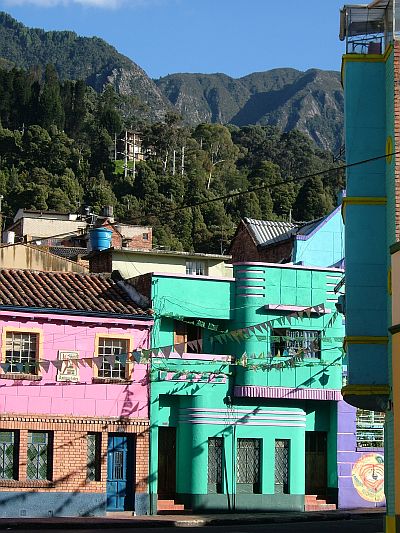
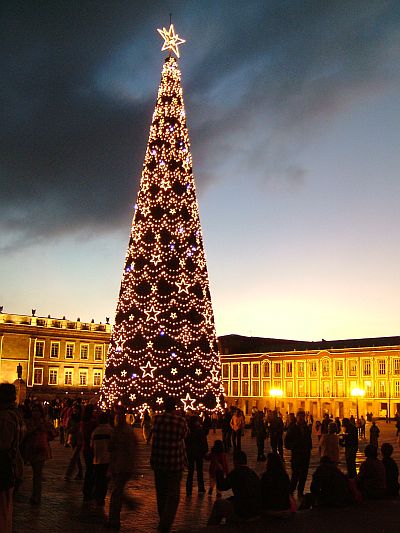
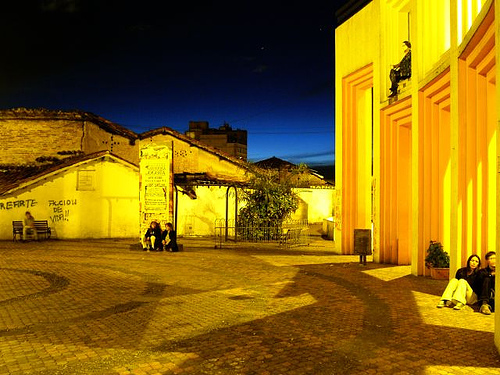
Many thanks to my friend Chris for letting me use some of his fantastic pictures of Santa Fe de Bogota (DC). See, I told you it was a nice place . . .


Monday, November 27, 2006

El Weekendo

As I write this darkness has fallen over Bogota, and so Bruno is beginning to demand his dinner by fixing me with his button-black eyes and whimpering. I suppose I'd better feed him before I carry on writing, or I'll get no peace.

I had my second Spanish lesson today, and got bogged down in direct and indirect objects. So now feel like I will never master the language beyond what's needed to argue with taxi drivers and point out sandwiches. I've also had some dispiriting experiences when out and about. I've had shopkeepers and waitresses not understanding my versions of words like jugo (juice), cenicero (ashtray) and cigarrillos (uh?). But yesterday was the worst, when the lady in the laundrette asked for my name and I replied "Jorge". I'm sure I said it right (you have to think of an asthmatic Welsh donkey braying backwards to get something like "khhorr-khhayy"), but I ended up having to write it down - leaving her, no doubt, with the impression that us foreigners are so stupid we don't even know our own names.

Although, having said that, I should admit that there may have been a few moments over the past weekend when that was true. Things got off to an early start on Thursday when Hitchen Dave and I were invited to American Dave's posh restaurant for an invite-only Thanksgiving meal. Us English gourmands got there shortly after lunchtime to see if there was anything to could do to help, but the gigantic turkey was already being kicked into the oven and everything else was in capable hands. So we just offered enthusiastic verbal assistance from the bar while making a start on the bottle of House of Lords whisky we had found in San Androsito - the paramilitary-run blackmarket area where you can buy everything from next month's movies to next year's cameras. It's an amazing place and proof, if needed, that rampant capitalism is hard-wired into the human soul. The whisky is a good case in point - so far as I know it's only officially available from the distillery in the Scotish Highlands or in the Upper House bar at the Houses of Parliament.

Perhaps it was because of the whisky that Dave and I both found it rather touching when Dave, the host, asked us all to join hands to say grace. It was perhaps the first non-sarcastic or silly preprandial blessing I've ever experienced. Usually someone either says "grace, tee-hee-hee" or "for what we are about to recieve may God make us truly . . . immune, tee-hee-hee." But Dave's version was sweet and sincere and made sense of what Thanksgiving was all about. Previously I'd assumed it was because the gluttonous Yanks couldn't climb around enough turkey in one sitting on Christmas Day. Now I know it's something about, um, er, who am I?

Friday, and to a birthday party for Australian Nicole. Her boyfriend John had nagged and cajoled enough to get everyone round to their apartment on time, so we could all lie in wait to surprise her when she came in. It worked reasonably well, except that because of a mix-up with phone calls we all ended up squatting in the dark for a good half hour trying not giggle before she arrived back. The surprise-factor was heightened by the fact that she thought she had been burgled again (and was on the brink of having the screaming heeby-geebies) when we all jumped out, roaring our best wishes.

Saturday got off to a slow start after waking up at Nicole and John's apartment, hunched up the same place I'd previously been hiding - the foot of their bed. After a few welcome cups of tea and some peculiar soup I wandered round the corner to Dave's house, where he was settling in to watch the new James Bond film (available for weeks gone by at San Androsito). It seemed like a sensible course of action for the afternoon until his Norwegian housemate brought his visiting brother back from the airport and insisted we join them in Nordic-style shots of whisky. It's difficult to refuse a pair of identical looming things with glacial stares and no eyebrows.

I should perhaps explain why Dave, who married just a few months ago, now has a Norwegan lodger. Sadly, he and his wife, Margarita, have found it difficult to get on and have separated. It's a particular shame because they are expecting a baby together any day now. But when two people see their futures on different sides of the world, things can become fraught.

After a boozy afternoon of watching Bond and saying "skol" a lot, it was back to the pimp-palace in the sky to cook dinner for Nicole et al. As per her birthday wishes it was spagetti bolognaise and potato bake.

Sunday was a lot more civilised, as I met up with my friend Julianna for an art exhibition called, unpromisingly, ArtBo. The quality of the art and the sheer scale of the event were quite staggering, underlining just how much money there is in this city. Also apparent was in whose hands that money is - clearly one was walking among the elite. People were taller, skin was paler and more heads were blonde. I would challenge anyone dropped into that hall from space to have more than an inkling that they were in South America, let alone Colombia. As with all cultural events here, it was absolutely packed - as it deserved to be.

Here are two pictures from Nicole's party on Friday night:
PS - to everyone at home who asked me why I like Bogota so much, you may find some clues in the second picture. Oh, and the first, come to think of it.

Monday, November 20, 2006

Back to the Bog

I'm writing this in my flat in Bogota, still trying to get my bearings after the trip back. The weather outside is cool and pleasant, which everyone is pleased about because while I was away there was a month of uninterrupted downpours. Wafting through the window are the dulcet tones of our neighbourhood tramp, who shouts obscenities at passing cars while chasing them down the street flailing his arms. Face-to-face he's a different man, very quiet, shy and sweet. He's got some sort of nervous condition that leads him to constantly pick at a red raw scab on his forehead. I always try to give him money when I can, and he's similarly looked after by everyone else in the neighbourhood, despite the rudeness of his cursing. Perhaps he helps stop motorists using the street as a shortcut.

Bruno, Sam's dog, is sulking on the sofa, because no sooner have I arrived home than his master has left for a week in the states. Apparently, while I was away, he spent much of his time chewing my duvet. Whether this was in protest at my absence or out of longing for my return is impossible to say, but either way it now smells of dogfood and is in desperate need of a clean.

I got hauled up by police this morning when I took him for a walk on a field behind the flat. While I was waiting for him to do his business I leaned against a tree and smoked a roll-up. Before I was even half way through two policemen on a motorbike came roaring up the track and started babbling about marijuana. They spent quite a bit of time examining my packet of Golden Virginia before they grudgingly accepted that it was only tobacco. They were reasonably pleasant about it, certainly a lot more gracious about accepting my innocence than that peculiar plod in Worcester.

Much less charming were the officials at Miami airport. While putting my stuff through the x-ray machine I took my laptop out of my backpack, according to instructions. However, I had left it wrapped in its thin woollen cover. "We have a laptop in a bag!" shouted the machine operator. Heads snapped up all around, as the cry was taken up by several voices. It was quite surreal, and they were obviously acting in accordance with some sort of drill. "Is this your laptop, sir?" asked one particularly surly official, "then come with me, sir."

I went to a side table with him and he began to swab it and run tests on a variety of sinister-looking machines. At this point I had a lurch of horror - it was being tested for explosives. I wondered how long I would have to spend in a cell before they accepted that the huge amount of gunpowder, cordite and other explosive compounds were there for purely innocent reasons. Poor blighters have been hauled off to Guantanamo Bay with much more convincing stories than mine. "So let me get this straight. sir. You were working in a fireworks shop for one month, without payslips or any employment records, in commemoration of a thwarted terrorist attack?" I didn't fancy my chances, but incredibly, all the results were negative. This despite the fact that the keyboard is visibly sparkly with traces of black powder. After this I had to go through the 'blower machine', which hits you with high pressure jets of air to dislodge and detect any explosive particles on your person. Again, nothing was detected, despite everything I own being covered in the same twinkly dust as my computer. I didn't stop to point this out to them; I'm afraid American homeland security will have to to its best without my help.

I've pretty much caught up with all my friends since I've been back. Most of them were at the opening of Sam's first Colombian art exhibition on Saturday night. I happily admit that I only usually go to these sorts of things for the free booze, but here any cultural event is incredibly well supported. This was no exception, it was heaving with people and I think he even sold a few pictures then and there.

I must have been drunk, because the next morning it was pointed out to me that I'd invited half the city round for Sunday dinner. Fortunately Dave was happy to help, and so about a dozen people ended up stuffing their faces on leg of lamb, roast potatoes and treacle sponge with custard.

As I said, I'm still trying to get my bearings - adapting to a new hemisphere, missing everyone at home who I hardly, if at all, got to spend time with, adjusting to the altitude, working out what to do next and debating whether to have another cup of coffee or risk walking Bruno again.

Friday, November 03, 2006

Sky monkeys with exploding coconuts

I'm writing this from the comfort of the 'executive suite', the small pocket of warmth I've created in the middle of my fireworks shop. Once upon a time it was some sort of reception area, so I have to lift the hatch to get behind the counter, where my mattress is. I've also got a desk, some padded chairs (like teachers used to get in assembly) and a tea table made out of a Molten Krypton box.

Today has been my first really busy day - so tomorrow and Sunday (November 5) should be even busier. Luckily Jo, my school friend from Wales, and Claire, a half-Turkish Worcester girl who saw my job advert in the window, are doing a great job of doing all the work.

I've just had an encounter with an off-duty policeman. I sold some fireworks to a lad who has been in quite often, so when he got his driver's licence out to prove his age I just waved it away and said “Don't worry, I remember you.” Truth be told, I remembered him because his licence card seemed unusualy flimsy. Just after he left the shop a red faced little man in a woolly hat strode up to the counter and flashed his wallet at me. I must have looked confused, because my first thought was 'why has he got a milk bottle top squashed into his wallet?'. Then I realised it was a police badge. But he did look like a man who would hoard old bits of tin foil.

“Did you check that lad's ID?” By this time he had adopted the wide-legged back-leaning stance of someone about to mete out righteous justice.

“Oh absolutely,” I said, “I've seen it before, he's been in a few times, he's actually nineteen.”

“Yeah? Well there's eight of his mates waiting round the corner. Do you really think he's going to a nice little bonfire party with those fireworks?”

Now I was really confused. I wondered if it really was a foil top in his wallet, and if this was an autistic attempt at conversation. “But he was over eighteen, how could I refuse him? I can't make prior judgements about how people are going to behave – as I'm sure you'd understand.”

For some reason this rankled him, so he fixed me with a beady stare while his mouth moved freely over his face searching, presumably, for some words to show me who was boss. He turned on his heel toward the door. And then turned on it again. As he spoke he jabbed his finger for emphasis: “I'm wat-ching you,” he said, in a really deep and scarey voice.

I didn't know what to say. “Ooh, goodness me. Thank you very much.”

He walked crabwise out the door, his quivering finger was the last I saw of him. I still can't work out why he got so cross with me. Maybe he mistook my confusion for smart-arsedness. Perhaps it was because when I smiled and thanked him for 'watching' me I was absently fiddling with the end of a big pink rocket. I don't know. He could have been jealous because I had so much cardboard to hoard.

Monday, October 16, 2006

Olde Worlde

I'm writing this from my fireworks shop in Worcester, where I arrived a few hours ago after travelling half way round the world, which never seems as big as people would have you think.

It seems particularly dinky right now because the Bummie bloke fitting the place out just told me he's got a friend in Bogota. "Ar. Me wife's mate. Bin there fuh years, she has. Er's a teacher." I knew exactly who he meant; I met Sarah last week at the Bogota Beer Company and she gave me lots of good advice about getting jobs at posh schools.

The last week or so in Bogota flew by in a blur of souvenir hunting, packing and checking I had my passport again and again and again. There's something about impending air travel that turns me into a compulsive obsessive. I get to within a whisker of the hand-washing and brick-counting stage.

John and Nicole had some terrible luck in the last week when they were burgled by a Colombian bloke who they thought was their friend. It seems he must have made copies of their keys at some point and then returned with an accomplice to steal everything they could carry, including a substantial amount of cash saved up by Nicole and carefully hidden in the flat. The Australians arrived home soon after the crime with Marco, a Maltese bloke who's teaching in Bogota to earn enough cash to finish building a house on the Caribbean coast. Just as they were noticing that things were missing a neighbour came to tell them that two suspicious-looking chaps had called when they were out. "One of them looked gay. He had an earring and a silly hat," she said. They instantly recognised the description as a bloke called Mosh, who had been going to their house quite regularly of late. Marco flared up. "Come on! We have to go to the pawnshop district. That's where we find the bastards!"

So off they went and, incredibly, they found the accomplice in the process of selling their DVD player. A fairly mild beating persuaded him to turn informant. "It wasn't me, it was Mosh, he's over the road in that brothel." Marco stormed in and extricated the thief from the arms of a fat and elderly hooker, and threw him down the stairs into the street. Marco (one of the mildest-mannered, relaxed people I've ever met) then set about him with John's belt, which eventually broke over the unfortunate's back. Mosh's screamed protestations of innocence and Marco's barrage of Maltese invective eventually drew the attentions of the local constabulary, who after hearing the story took Mosh away to prison. Then the hookers emerged from their various vantage points to swoon over Marco and offer him kisses, which he was loathe to accept given what, presumably, they had recently been doing with Mosh.

The footnote to the story is that after only a few hours Mosh paid his way out of prison with about fifty quid of Nicole's money. She and John were tipped off by a sympathiser at the police station when he was leaving, so they were able to have a taxi waiting at the prison gates to follow his movements. It turns out that he's headed up to Taganga, which, unluckily for him, is where Marco is building his house. He followed him up there the next day. "I needed to go up there anyway, and if I find him I will drown the bastard," he explained.

I had quite a treat on my last night in Bogota when, along with Dave, Margarita and Edward, I was invited to a posh restaurant to test a new creole menu. The place is run by an American chap called Dave, the scion of a long-established ranching family, who've been there long enough to bag the letter A as their cattle brand. The food was exceptional, but as I'd been invited in my culinary consultant capacity I tried to nit-picked for all I was worth. But after several courses and a couple of bottles of wine I was reduced to making appreciative noises and gesturing like an Italian chef describing his mother's way with tagiatelle.

And so to Miami, and the sudden shock of seeing fat people again. There are some porkers in Bogota, but these are usually big-bellied narco types whose lard rests on frames of murderous muscle. So one pretends not to notice. But at Miami airport you see some real wobbling waddlers. Colossal. The sort who have to throw their arms out from side to side when they walk, the better to shift their bulk. I saw one chap who, despite being unfathomably huge, was obviously some sort of courier. I wonder if the customer had a choice between express, standard or fat delivery? "Our big-boned service is much cheaper, sir, but it takes longer - particularly if there are stairs or bakeries along the way."

With such thoughts I passed a pleasant few hours before the uneventful flight to London. As on my last night in Blighty my friend Ian was good enough to put me up for the night. After a dash round Marks and Spencers I was soon salivating over a big plate of bangers and mash - you just can't get a decent sausage when you leave these shores, whatever the Canadians say. After catching up with the news I crashed out until the following afternoon when I woke up panicking that I'd left it too late to get a train to Pershore, and my brother's fortieth birthday party in the Talbot.

As it turned out I got to Paddington just in time for a train that disgorged me right on cue to wander into the pub as the party was in full swing. I should point out that nobody apart from Dave, my brother, had any idea I was coming home. The disbelieving double takes, particularly from my mum and dad, were like something out of an old Laurel and Hardy film.

A few days have passed since then, and I now find myself sitting in the back of a semi-derelict tyre-fitting workshop facing a month of paid incarceration.

The transition to work happened rather suddenly when my boss called at lunchtime. "George, I need you to get to Worcester and sort out the shop licence, right now." I reminded him that I didn't have a car at the moment. "Get an effing taxi - I paid for you to fly half way round the bloody world, I should be able to cover that." He explained that a woman who worked for him had been in and out of the licensing department getting fobbed off every time. Then he said something that I'll never forget. "It's got me right pissed off. I said to her, 'for eff's sake, I think you're just bloody incompetent, it can't be that bleeding difficult, for God's sake!' But you see George, she's a nun and she's lived a very sheltered life."

I'm still chuckling about that now as I write this and face a night sleeping in a cold, oily shed on a mattress made out of flattened firework boxes.

Thursday, October 05, 2006

Fireworks

I've always had a knack for indecision, but since getting back from Choco this has been elevated to exhibition standard. Should I buy a house in Bogota? What part of the city is best? Should I buy a house or a flat? What should I do with it once I've got it? Should I get a teaching job at one of the eighty universities here? Or private students? Journalism? Spanish classes? More travelling? What about Christmas? Wassailing?

I'd more or less decided that I was going to hurry up and buy something and then go home for a few weeks of midwinter festivity when I got an unexpected call that changed everything.

It was my former boss, the geezer who opens the dodgy firework shops that spring up all over England on autumn mornings, like so many mushrooms. God only knows how he got the number for the penthouse. "Are you going to work for me this year, or what?" It took me a few moments to work out who I was talking to. "Goodness, well, I don't know. Hello! I've been thinking about it, of course, but, er, no, you see, I'm in Bogota. Colombia. South America. The other side of the world." His response blew away any remaining cobwebs of indecision. "I want you there as soon as possible. Book a flight. I'll pay for it. See you next week." It was said as casually as someone offering to pay for a short taxi ride.

So it is that I find myself preparing for a flight next Wednesday, with a return ticket booked for the middle of November. Then I can come back to Bogota and get back down to some really serious dithering about what to do next.

To be fair to myself, though, I should say that I've been fannying about more than arsing around. My dithering has been of a reasonably proactive nature, and has involved a lot of walking around the city exploring new neighbourhoods. I've found corners of Bogota that look like chunks Oxford that have somehow been transported across the Atlantic. Lovely brick-built houses with leaded lights, tall gables and sandstone lintels around the doors and windows. You can almost taste the cucumber sandwiches and hear the click of croquet balls. The quality of the architecture is one of the most surprising things about Colombia. Le Corbusier built a lot in Bogota, and the Bauhaus architects from Germany set up a school here. But, for me, the best areas are those built in 'estilo Ingles'. There does seem to be an appetite for all things English among Colombia's rich. You often see businessmen in the financial area, not in sober grey suits, but sporting ensembles of tweed, corduroy and Shetland wool. Club-style ties and brown leather brogues complete the look, which is usually carried off with aplomb.

Despite these appearances, the business style here couldn't be more different than at home. A good case in point is that of estate agents. At home you would never dare give one of these people your phone number, for fear of constant harrassment. "Hello? Mr Martin? I've got another place you might be interested in. It's not quite where you were looking, it's in the Outer Hebrides, and it's not so much a house as a fire-damaged abattoir. But I thought you might want to take a look . . . " But here it's a different story. "Hola," I say. "I'm a silly gringo with more money than sense and I'd like you to sell me a house." Ker-ching, you'd think they'd think, but oh no. "Oh, er, right. We'll call you back tomorrow." And, of course, they never do.

I've also been teaching a few private classes recently, and it's felt nice to have a bit of money coming in. On top of this I've been doing rather well with poker, which has become a bit of a weekly tradition. We only play for a tiny amount of cash, but a half-decent win can cover a good night out - with enough left, as my grandad would say about his two-and-six, for a bag of chips on the way home.

Friday, September 15, 2006

Choco


I'm writing this with sunburn having returned yesterday from Choco, one of Colombia's most undeveloped and inaccessible areas, which is on the Pacific coast. It's also the wettest place in the world, but otherwise it's exactly what you'd expect from a poverty-stricken tropical paradise. Getting there took about 24 hours altogether, and involved a bumpy ten-hour bus journey through guerrilla-controlled territory and a flight on a chartered five-seater aeroplane over unexplored jungle.


I set off last week after hatching the plan with Jamie and Ben, two English lads, over a game of poker. We departed with some trepidation after hearing numerous warnings about a particularly nasty guerrilla group who control the road to Quibdo, the capital of the province. They are led by a young (reputedly beautiful) black woman and, although they number only about 50 fighters, have earned far-reaching infamy for their violent methods. Apparently, they stop buses, set them on fire and then shoot all the passengers. This lurking menace was perhaps the least unpleasant aspect of the journey, which was hot, deeply uncomfortable and twice as long as expected. Another minor unpleasantness during the initial descent from Bogota was the change in pressure, which caused the sort of splitting headache you get when you dive down too deeply in a swimming pool. The bends, I think, frogmen call it.

We arrived in Quibdo after dark and were dropped off outside a cake shop on the outskirts of town, absolutely exhausted. As we sat trying to get our bearings we found ourselves suddenly surrounded by three Beyonce look-alikes who started chatting us up. This perked us up immeasurably, but before anyone could ask if they wanted to show us around town later we found ourselves contemplating two DAS identification cards being flashed at us by a surly looking pair of blokes (the first two white people we'd seen since Bogota). "Passports!" said one. Ben and I were both keen to show off our new six-month student visas, which we sorted out the day before we set off. Jamie, however, looked sheepish as he pulled out a tattered scrap of grey paper, which he claimed was a photocopy of his passport. So, with rueful backward glances at our lovely friends of too few minutes, we were taken off for further questioning.

The agents were staggered to hear that we'd arrived by bus "Are you mad?" asked one of them. "It's very dangerous, didn't you have any problems?" We told them that it had been fine, and that our only problem had been meeting them. The joke, such as it was, didn't go down very well. "Come back here tomorrow morning at seven thirty," we were told. This second meeting was much more pleasant, as we were ushered into the presence of the regional bigwig of DAS, a heavy-set man with the slow, deliberate movements of an old boxer. "So, you came by bus. Are you mad?" he asked, fixing us with a penetrating gaze from under his drooping eyelids. A swift appraisal, I think, told him that we really were silly Englishmen looking for whales and not IRA weapons experts on our way to a guerrilla training camp. From this point onwards his imposing demeanor dissolved into fatherly concern. "Here is my name and my mobile phone number, if you have any problems get in touch with me. And when you get to the coast, don't stray from the villages or you will be kidnapped." We assured him we would be careful and thanked him profusely, feeling slightly guilty in the knowledge that we fully intended to explore the beaches and jungles outside the villages.

We spent one night out in Quibdo, in the company of a local chap who used to go to university with Pontus - a Swedish chap who studies economics in Bogota and has the dubious distinction of being Platypus's longest-serving resident. An e-mail was sent and our host, Ricardo, responded by turning up to our hotel with grand plans for a great night out. Like most Colombian towns Quibdo has a Zona Rosa; an area of (relatively) top-dollar bars and clubs, usually in the northern suburbs. In the case of Quibdo this was a slightly tatty square surrounded by a few bars and restaurants. Most of the best entertainment seemed to be reserved for the children - they had a hand-pushed miniature bus that made circuits of the plaza and a bouncey castle (but this was actually rather sinister; it was topped by a grimacing pumpkin head that seemed to leer obscenely at the children below as it lolled about - the dramatic thunder and lightning enhancing the macabre effect). Although Ricardo was determined to show us every hotspot in his town, we were all knackered and facing an early start to complete the final leg of our journey to the coast.

I never imagined that I would ever charter an aeroplane, but there is no other way of reaching the coast. They did start to build a road through the jungle, but constant attacks by guerrillas and paramilitaries brought the project to a halt. The plane we booked (for about twenty quid each) was a five-seater and no bigger inside than a London taxi. It was a great way to travel; we were under the clouds and so could see the green sweep of virgin rainforest stretching out in every direction, broken only by the toffee-coloured rivers that meander towards the sea. The flight was literally a hop, no sooner had we reached cruising height than we began descending towards the tiny airstrip cut through the jungle on the outskirts of Nuqui, which is variously pronounced "Newquay" or "Nookie" - two words which together form a fair summary of the place; it's a fishing village full of pregnant woman and babies.

It's also got the sort of tourist facilities you'd expect to find in Newquay. Even though we were the only visitors that we could see, we were amazed to be faced with a wide choice of decent places to stay. As it turns out, the Pacific coast is a well-kept secret among the rich of Medellin, who fly directly from their city to the airstrip in Nuqui. Because of this most people we met last week assumed we were Paisas, as they call folks from that neck of the woods. Often, when we told people that we were from England (a distant land, far over the sea), they would stare at us open-mouthed. We booked into a cabin in a so-called 'ecolodge' that had about sixty beds but no guests. Neither did the hotel over the way.

The next morning we were up at the crack of nine to go on a boat trip along the coast, which, we were told, would include a spot of whale watching. We didn't see any humpbacks, as it turned out, but our little boat was mobbed by a gang of dolphins. Sometimes I worry about myself. I keep hearing people talking about the deep sense of "inner peace" excited by these enigmatic and gentle denizens of the deep, but all I thought as they swam alongside us was "goodness me, I could probably hit one of these buggers if I had a shovel". I tried taking photographs with a film camera I borrowed from Sam, so I've got some lovely pictures of rippling water.

Despite not seeing any whales it was a great day. We chugged for about an hour up the coast and stopped on a deserted beach, where vast crowds of bright red crabs parted before us as we walked along the sand. Like everywhere along this coast, the sea and the jungle seem to be in constant competition - the forest creeps ever forward as the Pacific waves pound back. We had a walk into the rainforest and showered in a waterfall, which finally pounded out the knots left in our backs by the interminable bus journey. Then, walking back to the beach, we found ourselves in a lovely little restaurant being served cold home-made lemonade. Signs told us that we could take surfing lessons, exchange books, ask to see the menu or learn to dive there. Looking further up the slope, under the trees, we noticed a cluster of idyllic-looking cabins with crisp, white mosquito nets billowing through the windows. We were the only people there. We found a visitors' book and discovered that since the year two thousand we the first English people who had gone there, apart from a bloke called Keith, who recorded for posterity that he was an acupuncturist from Bristol who visited for tourism-related reasons and was en-route to Medellin. Everyone else who had filled in their details was from that town.

After further chugging, our next stop was a little village called Termal, so called because it has a thermal spring nearby. To get to the spring we had to walk for about two hundred yards along a well-weeded path overhung by a natural pergola of hibiscus. It was quite surreal to come to what felt like the very heart of darkness only to find that Alan Bloody Titchmarsh had apparently been there before us. The spring flowed into the side of a river that wound its way from the depths of the jungle. A hexagonal concrete barrier had been constructed around the source to catch the water and form a plunge pool. It was lovely, despite the sulpur causing the most incredibly eggy smell. This came at a time when my aversion to seafood had left me with no option but to eat scrambled eggs for three consecutive meals. Eggtastic. It was particularly pleasant when the heavens opened and the rain filtered down through the canopy overhead. It was apparently because of this rain that we didn't see any whales on the way back. We were told they only surface and mess about when it's sunny and warm. But we did see flying fish, which were amazing. I thought they just relied on their momentum to break surface and glide for a while, but the ones we saw were flapping their wings and zipping along like bumble bees.

The following day was chiefly occupied in ensuring our escape from this tropical paradise. Ben had realised he'd run out of money and Jamie and I had to count every peso to make sure we had enough for another day and another chance to see whales. We got up early and went to the airport to book our flights, and started asking questions of the man at the counter. He listened patiently to all of our queries and then shot us a look that clearly said: "I may be wearing airline livery, and be standing behind a airport helpdesk, but what on earth makes you think I know anything about air services?" Eventually he told us that we would have to go to the airline office at some time after lunch. "Where is it?" we asked. He giggled and pointed generally towards the town - it's not the sort of place that has street names. Luckily, since arriving in town we had picked up a praetorian guard of ten-year-old lads, who Jamie and Ben played football with at every opportunity. (These were great kids and it was really sad when some of them pointed out their mum - a washed up old tart, mother of ten, drunk in the street at six in the evening, dancing alone in a puddle of dirty water.) With their help we found the office - which was a cluttered dining table in an untidy kitchen, in an unmarked family home, in a narrow alleyway off a side street. The woman in charge was quite flustered when we arrived, and asked us come back in half an hour. When we returned we found the kitchen slightly tidier, the many children more smartly dressed and a pen holder placed on the dining table, alongside an official-looking pile of paper. To be fair, she was one of the most competant and helpful airline representatives I've ever met.

While we were waiting for confirmation a local woman came in to book a flight. She had that rare (and difficult to visualise) species of beauty that somehow manages to pour the grace of a gazelle into the buxom mould of a medieval tavern wench. She started chatting to us and told us that the following night there would be a big party going on in the town. "I have girlfriends," she said, running a polished fingernail along the low-cut collar of her skin-tight t-shirt. "We'll take you out for a party." We all boggled, momentarily, and then Ben had the presence of mind to ask that all-important question: "How old are you?" She fixed us with steady gaze, leaned languidly back in her chair, slowly crossed her long slender legs and teased her fingers through her hair. Then, with a twinkle in her smile, she said: "Fourteen." We thought better of taking her up on her offer. If for no other reason we'd earlier played pool with a chap who'd had his hand cut off with a machete for theft. We didn't like to think what the price might be for deflowering virgins. Not that she was, of course, being a mother and all that.

The next morning Ben set off to Bogota while Jamie and I headed off for another trip, this time to the north, towards the most remote bar in the world, travelling in hope of seeing whales along the way. This time the trip started in the middle of town, as opposed to from the beach, because a ferocious nocturnal storm had left most of Nuqui underwater.

And, yes, we did see whales along the way. Humpbacks, they were. Gigantic things, leaping out the water all around us and slapping their fins onto the waves. At one point two jumped clear out of the sea, side-by-side, in perfect unison. The sound they made when they blew out their snot will stay with me forever, and I was impressed. But as spectacles of nature go, I'd rather watch pigeons collecting twigs for nests or three-legged dogs clambering through catflaps. Again, I tried to take some photos, but I only got a distant tail, and that was just a fluke.

We were particularly lucky to see the whales because the captain of our ship was looking for other things. For most of the journey we followed the line between shallow and deep water that was marked by an unbroken line of flotsam and jetsam. It soon became apparent that he was acting on information that some smuggling ship had hastily disposed of a consignment of cocaine. He didn't find anything, but I'm sure he'll keep looking; a lucky break like that could transform his life.

Our destination, three hours from Nuqui, was a tiny village called El Valle. I would have called it a 'one horse town', until we happened to be waiting in a shop when two of the things were led behind the counter into the storeroom-cum-stable out the back.

After eating another plate of scrambled eggs and coconut rice we walked off down the beach in search of the world's most remote bar. It was a three-hour trek across hot sand and over sharp rocky outcrops. It should have been two hours, but we walked past it for half an hour and then had to go back again. But we found it in the end. There, on a rock, which is on the beach during low tide and out to sea when the tide is up. After we had climbed the steps up to the bar we were welcomed by the landlord, who had already opened the beer, which was the coldest and most pleasant I've had for some time. As I sat enjoying it (looking out to the horizon, imagining every distant splash to be a whale) I reflected that if I ever got the urge to come back here in the future I would have quite a trek. First, I'd have to walk up past the High School, towards Pinvin, to the station, catch a two-hour train to Paddington, get the Heathrow Express to the airport, then the 18-hour flight to Bogota followed by the night bus to Pereira and the bone-rattling trek through homicidal-guerrilla-controlled territory, which would lead onto the chartered flight from Quibdo over untrodden emptyness and then the boat for hours through floating drugs. And then the walk, and sunburnt feet. I thought it would be wise to have a few more beers while I was already there.

Like the fourteen-year-old at the airline office, the captain of our boat and the navigator also told us that there was a big party happening in Nuqui that night. The navigator was particularly enthusiastic, he said that it was the annual celebration for the local school that his three daughters went to, and that it would be a big party. I assumed it was like a school disco that the parents (presumably having gone there themselves, once upon a time) all got involved in. But I knew better when I saw his El Valle girlfriend waiting for him to arrive at that particular port. She was in her school uniform - and obviously younger than at least two of his daughters. The big party was exactly like a school disco run wild. At one point a mob chased three soldiers, armed with machine guns, out from the centre of town. We also saw lads, no older than twelve, tucking guns into their waistbands. I told myself they were fake, and I'm sure they were. But it was an unsettling, edgy atmosphere, particularly with all the old sailors flapping around in their flip-flops examining the latest crop of thirteen-year-olds.

Alarms were set for an early start and a flight back to Quibdo the next morning, but hours before the beeping I was woken up by the most violent electrical storm I've ever cowered beneath. I assumed we wouldn't be able to fly, but after a delay of a couple of hours we set off despite the thunder and lightning.

That, I suppose, was the end of the trip. Jamie and I decided to fly back from Quibdo to Bogota, not so much from the threat of being killed by psychotic narco-terrorists, but more because we couldn't face the uncomfortable bus seats again.

After only a week away I've arrived back in a very different Bogota. John has left and Edward, another English chap, has moved in. Jess has also left and tonight is Jamie's last night, so I have to stop writing now and go out to be ridiculous.

Monday, September 04, 2006

Manizales

Again, days have been ticking past and clicking into weeks with alarming regularity. My days are often taken up with the sort of small chores that could be achieved in a half-hour lunch break at home. But this is Bogota and nothing is ever as simple as it seems. But I really can't be making any excuses, much of my time has been expended on dithering and prevaricating about what to do next. No sooner do I decide that I'm going to buy a house here and stay for a good while than I change my mind again. But now I'm sure that I'm going to go for it. I think.

Leastways, I've started to sort out a six-month student visa. I've signed up for one of Sam's art courses that start in a couple of weeks. It should be interesting - two afternoons a week painting naked ladies and earthenware jugs.

Much to the surprise of my friends I managed to leave Bogota last week. On the spur of the moment Sam and I decided to get a bus to a town called Manizales, which sits on the edge of snow-capped mountains in the coffee region to the west of the country. It's a very civilised town which sits in lofty isolation at nearly the same altitude as Bogota. Despite its remoteness the people there are very outward-looking and westernised - sometimes it was difficult to remember that I wasn't in a European city, particularly as a lot of the locals were tall and blonde. Judging from the number of agencies on the main street, I would guess that catwalk models are one of the area's major exports. We had plans to do all sorts of wholesome and interesting things involving mountains, snow, hot springs, coffee fincas and jungles, but these plans went out the window shortly after we arrived and the owner of the hostel (a very lovely Paisa from Medellin) took us under her wing. No sooner had we dropped off our bags than she was ushering us into a taxi for a night out with her friends. The club we arrived at cost a couple of quid to get in and then had a free bar all night. I tried to take it easy, but (bizarrely) Colombians kept offering me drinks. "Thanks, but they're free, amigo," I would say, "I'll pick up another when I've finished this one." "No, no, I give, I give, drink!" What could I do? I didn't want to be rude. This pattern continued for a couple of days until we decided that, for the sake of our health, we should hop on a plane and get back to the relative sanity of Bogota as soon as possible.